With many Technology stocks trading near all-time highs, value investors may question having exposure to an area of the economy where demand for new technology has been unprecedented.
At Heartland, we use our time tested 10 Principles of Value investing™ to guide every decision. When evaluating attractive investment opportunities in the sector, we take an in depth look at both qualitative and quantitative characteristics to identify companies with a high probability of creating outsized shareholder value, and like investments in any sector, attractive opportunities begin with disciplined valuation analysis.
Technology stocks are often more asset light than other sectors in the market, causing investors to often find lower correlations between stock prices and Price to Book Value. As a result, valuation metrics such as Enterprise Value/Sales, Enterprise Value/EBITDA, Enterprise Value/Free Cash Flow and Price/Earnings, working in tandem, often provide better insights into a company’s earning power and long-term value potential.
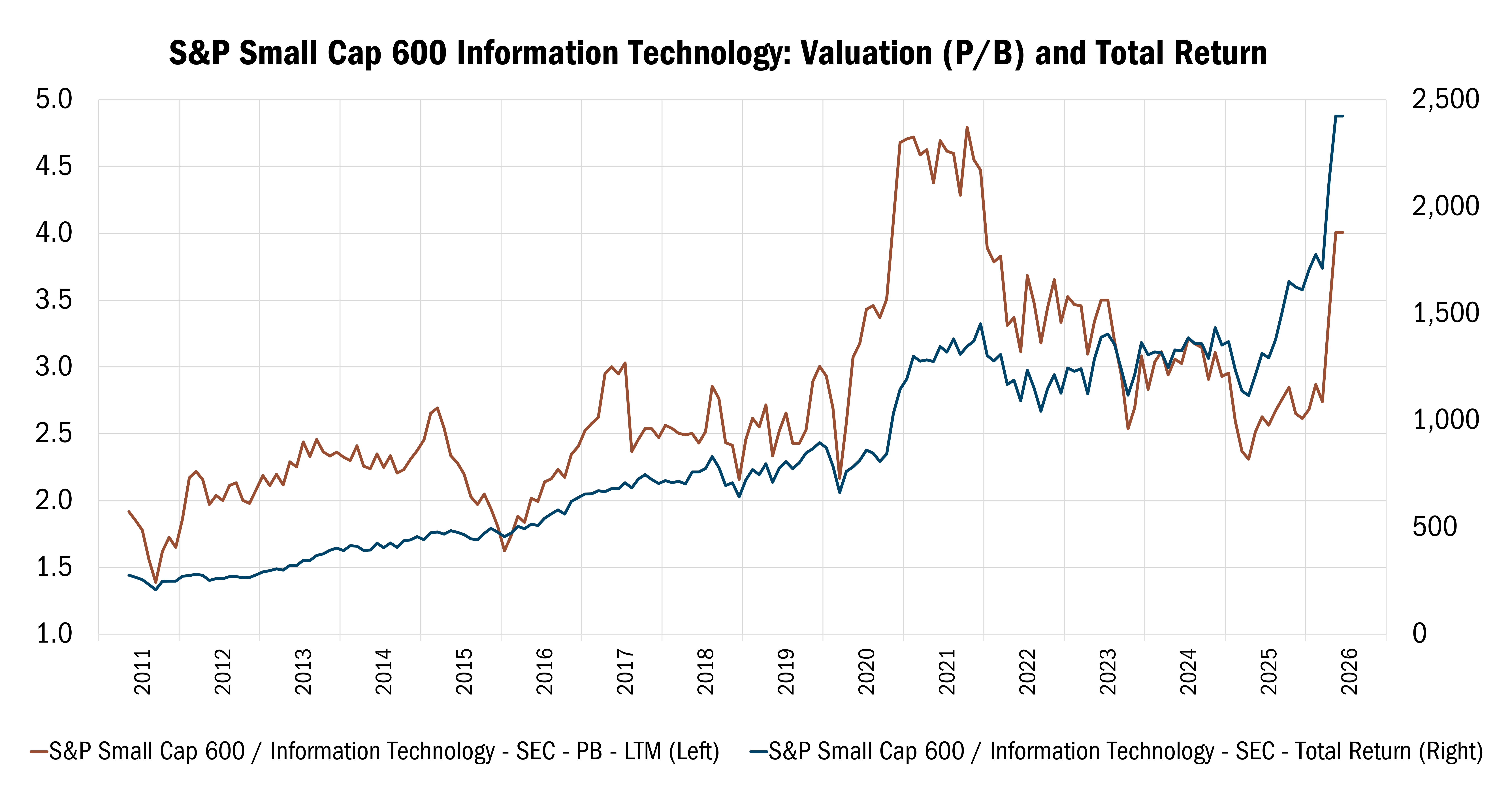
Source: FactSet Research Systems Inc. Monthly data 6/30/2011 to 6/1/2026. The data in this chart shows the S&P SmallCap 600 Information Technology sector's valuation (P/B ratio) and total returns. The S&P SmallCap 600 Information Technology Sector measures the performance of U.S. small-cap companies in the tech industry. All indices are unmanaged. It is not possible to invest in an index. Past performance does not guarantee future results.
Competitive advantages in technology often have shorter lifespans than in other industries, making qualitative analysis especially important. Investors may consider questions such as: how long can this company sustain sales growth? Where do they fit in the value chain? And, what makes them unique?
While valuation provides the starting point, understanding the durability of a company’s business model is equally important. We believe MOATs are essential to long-term success in any industry, but they are particularly important in technology, where rapid product innovation can quickly wear away competitive advantages. These considerations are particularly relevant today, as investors weigh the potential impact of AI across the technology landscape. In our view, the risk of disruption is not uniform across the software industry, and distinguishing between companies with durable competitive advantages and those more vulnerable to change is increasingly important.
In today’s environment, when assessing opportunities across Technology against our 4 price targets, we are finding more favorable value and risk-reward characteristics in areas where the market fears disruption; making the qualitative aspect of our 10 Principles of Value Investing™ key. We look for opportunities where stocks facing concerns about AI disruption may have been overly punished relative to the company’s future prospects.
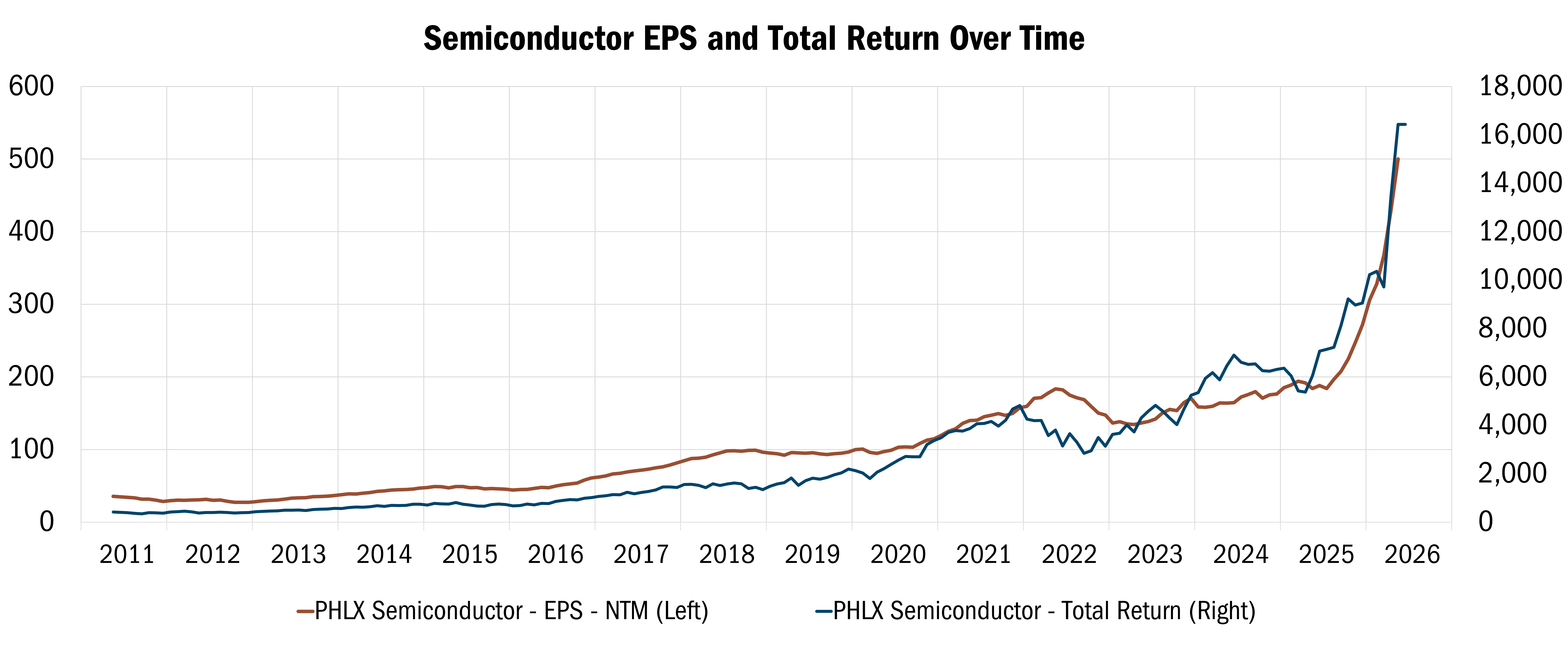
Source: FactSet Research Systems Inc. Monthly data 6/30/2011 to 6/1/2026. The data in this chart shows the PHLX Semiconductor Sector EPS and Total Return over time. The PHLX Semiconductor Sector Index (SOX) is a benchmark stock index that measures the performance of 30 U.S.-listed companies engaged in the design, manufacturing, distribution, and sale of semiconductors. All indices are unmanaged. It is not possible to invest in an index. Past performance does not guarantee future results.
The future is uncertain; therefore, investors need to understand expectations to deliver consistent outperformance in any market. With earnings expectations, and in many cases valuations, elevated in industries like semiconductors, we’ve been inclined to reduce exposure to outsized winners that have garnered premium multiples against outsized fundamental strength. While industry fundamentals remain strong, our bottom-up research continues to identify semiconductor companies whose long-term potential we believe are still underappreciated.
At the same time, we believe diversification remains essential to deliver consistent results. In addition, high valuations, particularly in cyclical peak environments often limit future returns. While timing and magnitude of technology cycles are uncertain, future returns are generally heavily influenced by the price paid. As a result, we continue to focus on businesses with durable fundamental improvements that are trading at attractive prices.


©2026 Heartland Advisors | 790 N. Water Street, Suite 1200, Milwaukee, WI 53202 | Business Office: 414-347-7777 | Financial Professionals: 888-505-5180 | Individual Investors: 800-432-7856
Past performance does not guarantee future results.
Investing involves risk, including the potential loss of principal.
There is no guarantee that a particular investment strategy will be successful.
Sector and Industry classifications are sourced from GICS®. The Global Industry Classification Standard (GICS®) is the exclusive intellectual property of MSCI Inc. (“MSCI”) and S&P Global Market Intelligence (“S&P”). Neither MSCI, S&P, their affiliates, nor any of their third party providers (“GICS Parties”) makes any representations or warranties, express or implied, with respect to GICS or the results to be obtained by the use thereof, and expressly disclaim all warranties, including warranties of accuracy, completeness, merchantability and fitness for a particular purpose. The GICS Parties shall not have any liability for any direct, indirect, special, punitive, consequential or any other damages (including lost profits) even if notified of such damages.
Value investments are subject to the risk that their intrinsic value may not be recognized by the broad market.
The statements and opinions expressed in the articles or appearances are those of the presenter. Any discussion of investments and investment strategies represents the presenters' views as of the date created and are subject to change without notice. The opinions expressed are for general information only and are not intended to provide specific advice or recommendations for any individual. Any forecasts may not prove to be true.
Economic predictions are based on estimates and are subject to change.
Heartland’s investing glossary provides definitions for several terms used on this page.