Agricultural equipment dealers, manufacturers and fertilizer companies have been on our radar for several months, as their setup reminds us of other cyclical opportunities we have discussed. These include businesses with strong fundamentals and an ongoing downturn, which we believe could create an interesting opportunity if the underlying environment improves. To discover if an opportunity truly exists, we aim to look beyond the company itself and really understand the broader circumstances.
Talking to people that are closest to the cycle can be helpful. In the case of agriculture, this includes the farmers, dealers and the major original equipment managers (OEMs). We want to know what their consumers are saying about their own financial situation. Are they replacing their old equipment or are they holding off? Are dealers seeing increasing demand? What are manufacturers seeing from their orders?
These types of conversations give us the qualitative picture, when using our 10 Principles of Value Investing™, which is Heartland’s process for all buy and sell decisions. Then we test that picture against the data, which is the quantitative part of our process.
One of the principles used to analyze a business is Financial Soundness. In this case, we are evaluating the financial soundness of the agriculture industry at the customer level. A strong balance sheet of equipment manufacturers matters, but so does the financial health of the farmer that is buying their equipment. Farm income, spending, debt, expenses and commodity expectations can all influence customers’ ability and willingness to buy.
We use the same approach for all the companies we research, and part of this involves understanding the business and its market. We use industry-specific indicators to assess the financial health of these businesses, which makes the data particularly useful in our process. In agriculture, for example, USDA farm-sector income forecasts help us understand the financial health of farmers and their ability to buy agricultural equipment (see the chart below).
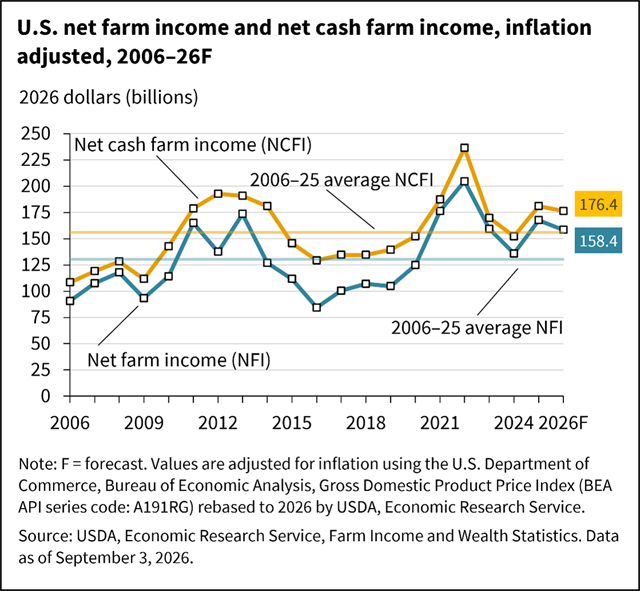
Source: U.S. Department of Agriculture, Economic Research Service. Annual data as of 9/3/2026. The data in this chart shows that U.S. farm income fluctuated significantly from 2006–2026, reaching a peak in the early 2020s before declining but remaining above the historical average. All indices are unmanaged. It is not possible to invest in an index. Past performance does not guarantee future results.
Information from charts like these helps investors understand the purchasing power of consumers within an industry. Continuing with the example of agriculture, we see that while farm incomes have decreased from the highs seen around 2022, but they still remain strong and above average. This suggests that farmers can still afford to buy equipment, but they might be more cautious when spending verses higher income years. We believe understanding industry conditions is important and helps us support our investment ideas, as changes in the economic environment can affect each sector differently.
Understanding the basics of each industry provides another important piece of the investment picture. These vary, but the objective is similar, we want to understand what determines supply, demand and ultimately customer activity. In the case of agriculture, the USDA’s World Agricultural Supply and Demand Estimates (WASDE) report helps us make this determination with regard to agriculture commodities.
As an example, when considering the use of corn, soybeans, and wheat, directional changes from year to year provide useful industry insight (see the chart below). Changes in production, demand, and inventories can affect commodity prices and the companies that depend on them.
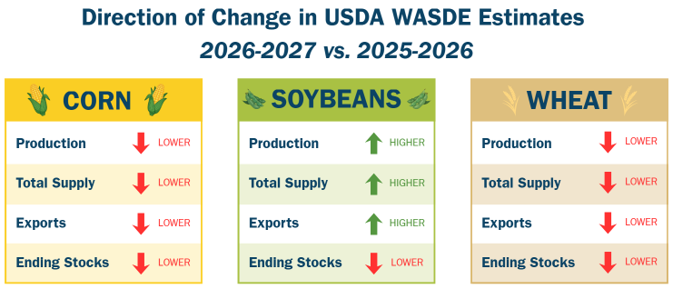
Source: U.S. Department of Agriculture, World Agricultural Outlook Board. Monthly WASDE report. Monthly data as of September 11, 2026. The data in this graphic represents annual/marketing-year projections for 2026/2027 compared with 2025/2026. All indices are unmanaged. It is not possible to invest in an index. Past performance does not guarantee future results.
Additionally, we consider sentiment and expectations through sources such as the Commitments of Traders. Understanding how producers, merchants and speculators are positioned helps us determine whether a price trend is backed by knowledgeable industry insiders or driven by speculation.
There is no singular data point the educates our investment decisions. We use all the data collected paired with our analysis to draw conclusions and identify if a cyclical recovery may be underway.


©2026 Heartland Advisors | 790 N. Water Street, Suite 1200, Milwaukee, WI 53202 | Business Office: 414-347-7777 | Financial Professionals: 888-505-5180 | Individual Investors: 800-432-7856
Past performance does not guarantee future results.
Investing involves risk, including the potential loss of principal.
There is no guarantee that a particular investment strategy will be successful.
Value investments are subject to the risk that their intrinsic value may not be recognized by the broad market.
Sector and Industry classifications are sourced from GICS®.The Global Industry Classification Standard (GICS®) is the exclusive intellectual property of MSCI Inc. (MSCI) and S&P Global Market Intelligence (“S&P”). Neither MSCI, S&P, their affiliates, nor any of their third party providers (“GICS Parties”) makes any representations or warranties, express or implied, with respect to GICS or the results to be obtained by the use thereof, and expressly disclaim all warranties, including warranties of accuracy, completeness, merchantability and fitness for a particular purpose. The GICS Parties shall not have any liability for any direct, indirect, special, punitive, consequential or any other damages (including lost profits) even if notified of such damages.
The statements and opinions expressed in the articles or appearances are those of the presenter. Any discussion of investments and investment strategies represents the presenters' views as of the date created and are subject to change without notice. The opinions expressed are for general information only and are not intended to provide specific advice or recommendations for any individual. Any forecasts may not prove to be true.
Economic predictions are based on estimates and are subject to change.
Heartland’s investing glossary provides definitions for several terms used on this page.


