After years of watching small cap stocks trail large caps, investors may ask themselves if they should even give small caps another look. If you can learn one thing from history, it is that trends tend to repeat themselves. Looking back at historical trends can offer investors the support to stay curious.
Small cap and large cap stocks have historically taken turns leading the markets over long stretches. At several times, small cap stocks relative trailing 10-year returns fell behind those of larger companies. While that could be a reason for investors to turn on small caps, those periods appeared to be only temporary. So, what could happen next?
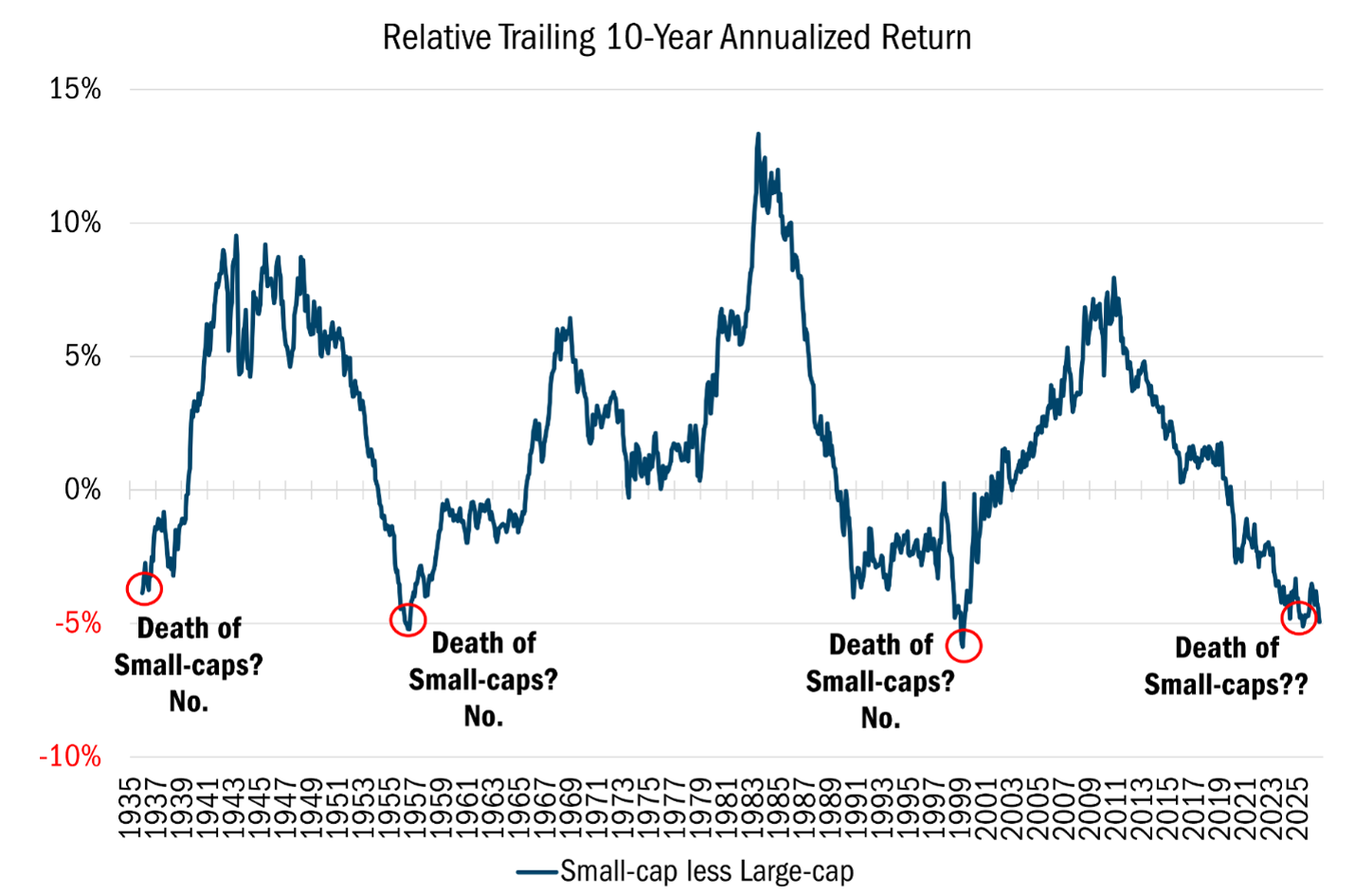
Source: Furey Research Partners. Data as of 9/30/2026. This chart represents the comparison of small cap stocks versus large cap stocks over rolling 10-year periods. All indices are unmanaged. It is not possible to invest in an index. Past performance does not guarantee future results.
Over the five years following each of the historical lows seen in the chart above, December 1935, July 1956, and March 1999, small caps outperformed large caps each time.
The results showed different returns, but a similar story. After December 1935, both groups delivered returns, small caps finishing slightly ahead. After July 1956, both returned double digits, yet small caps still finished ahead. The largest notable difference in returns was after March 1999, when the forward five-year annualized return for small caps was 12.38% versus a 1.20% loss for large caps.
Although it is true that small caps have suffered lows following their forward five-year returns for each of their historical lows noted, they have delivered better returns than large caps. For long-term investors, we believe looking at these trends in history is a reason to keep asking questions and looking for attractive investments, even when small caps are out of favor in the market.
History cannot tell us when small caps will regain favor, that’s impossible. What it can do is challenge the assumptions and give investors a reason to take a closer look at opportunities in small caps, while their potential could be overlooked.
Understanding the small cap market goes beyond recognizing historical patterns and evaluating the potential for good investments. This requires a process for understanding the businesses and the ability for them to be profitable. The profitability comparison makes that work particularly relevant.
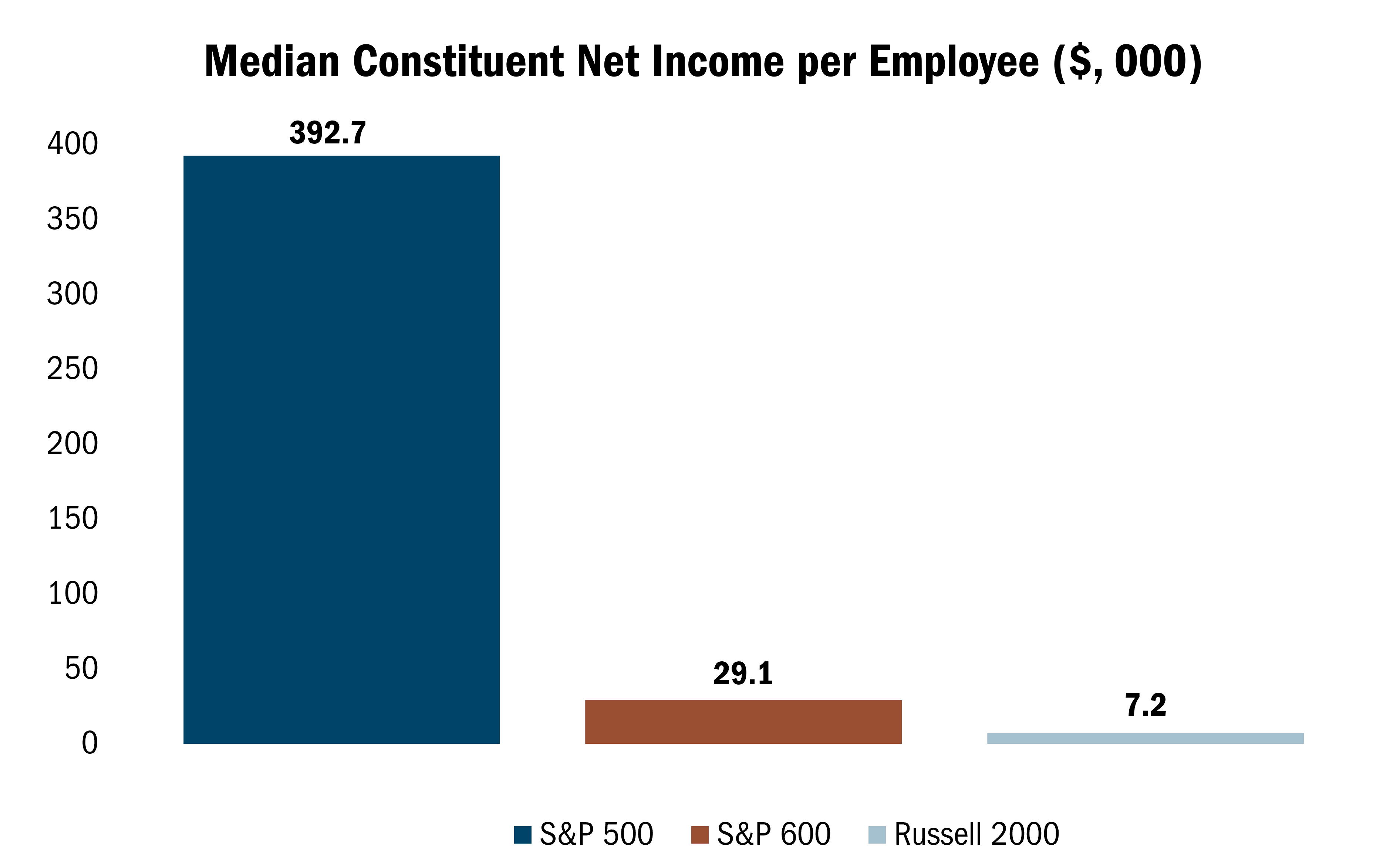
Source: FactSet Research Systems Inc. As of October 2026, company financial filings, latest fiscal year-end data available The data in this chart represents median constituent net income per employee for the S&P 500, S&P 600, and Russell 2000. Each company’s most recent fiscal year-end is used; fiscal year-end dates vary by company. Russell Investment Group is the source and owner of the trademarks, service marks and copyrights related to Russell Indices. Russell® is a trademark of the Russell Investment Group. Russell 2000® Index includes the 2000 firms from the Russell 3000® Index with the smallest market capitalizations. S&P 500 Index is an index of 500 U.S. stocks chosen for market size, liquidity and industry group representation and is a widely used U.S. equity benchmark. S&P SmallCap 600 Index is a group of 600 U.S. stocks chosen for their market size, liquidity and industry group representation. All indices are unmanaged. It is not possible to invest directly in an index. All indices are unmanaged. It is not possible to invest directly in an index. Past performance does not guarantee future results.
The median net income per employee for S&P 500 constituents is roughly 55 times that of Russell 2000 constituents. However, the S&P 600, which represents a segment of the small-cap market, reports median net income per employee roughly four times that of the Russell 2000. This difference highlights that profitability varies considerably across smaller companies, reinforcing the importance of identifying businesses with strong fundamentals and the potential to improve.
Looking ahead, advances in artificial intelligence could provide another chance for small-cap companies to improve productivity, streamline operations, and expand profitability. While these benefits will vary by business, companies that successfully adopt new technologies could create meaningful value for investors.
Low profits don't automatically make a company a bad investment but could just reflect a temporary challenge or a business that is still developing. An attractive investment is generally revealed when investors understand the business.
Having a disciplined process to uncover these opportunities allows investors to distinguish a good investment from a bad one, which is why we have stuck to our process, our 10 Principles of Value Investing™, for over four decades.
Heartland’s 10 Principles of Value Investing™ guide all our buy and sell decisions and are made of metrics which assess businesses from a qualitative and quantitative approach. Looking at market history gives us perspective, but we believe fundamental research gives us conviction.
The next chapter of market leadership has yet to unfold, but when small caps gain the spotlight, the businesses worth owning will likely have already rewarded those who recognized their value early. At Heartland, we are searching for those businesses worth owning, using our 10 Principles of Value Investing™. History has indicated that the spotlight will shine back on small caps, and when it does, our process will help us stay prepared.


©2026 Heartland Advisors | 790 N. Water Street, Suite 1200, Milwaukee, WI 53202 | Business Office: 414-347-7777 | Financial Professionals: 888-505-5180 | Individual Investors: 800-432-7856
Past performance does not guarantee future results.
Investing involves risk, including the potential loss of principal.
There is no guarantee that a particular investment strategy will be successful.
Russell Investment Group is the source and owner of the trademarks, service marks and copyrights related to the Russell Indexes. Russell® is a trademark of Russell Investment Group.
Small-cap investment strategies, which emphasize the significant growth potential of small companies, have their own unique risks and potential for rewards and may not be suitable for all investors. Small-cap securities are generally more volatile and less liquid than those of larger companies.
Value investments are subject to the risk that their intrinsic value may not be recognized by the broad market.
The statements and opinions expressed in the articles or appearances are those of the presenter. Any discussion of investments and investment strategies represents the presenters' views as of the date created and are subject to change without notice. The opinions expressed are for general information only and are not intended to provide specific advice or recommendations for any individual. Any forecasts may not prove to be true.
Economic predictions are based on estimates and are subject to change.
Heartland’s investing glossary provides definitions for several terms used on this page.


