As active managers, we’re free to invest in only those companies we want to own: attractively priced, financially sound businesses that adhere to our 10 Principles of Value Investing™. This flexibility is particularly useful in markets like this, where valuations are stretched and investor emotions and speculation are heightened.
But this doesn’t mean we ignore the market indexes. We don’t. For instance, we are closely following the upcoming semi-annual reconstitution of the Russell 2000® Value Index, when some existing members will be removed from the benchmark while other stocks will be brought in to better reflect the U.S. small-cap value market. As a result, sector weightings, which are constantly in flux (see the table below), could change noticeably, along with the industry make-up of those sectors.
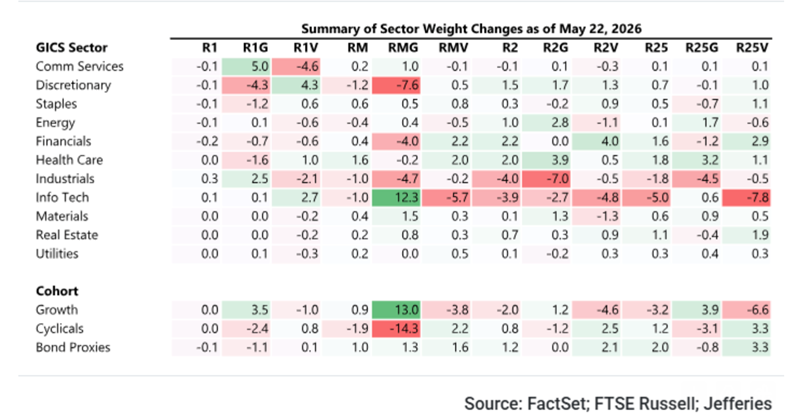
Source: Jefferies, with data included from Factset Research Systems, Inc. and FTSE Russell. As of May 22, 2026. This table shows how sector and style-factor portfolio weights (e.g., Technology, Financials, Growth, Cyclicals) have shifted across different Russell® index rebalance stages, with green indicating sectors gaining weight and red indicating sectors losing weight. All indices are unmanaged. It is not possible to invest in an index. Past performance does not guarantee future results.
Why does that matter? There are several reasons. For starters, passive index funds enjoy a significant share of investment dollars, which means index funds hold significant sway on how the market behaves, including our part of the market. Since the Russell 2000® Value Index is the benchmark for the Heartland Value Fund (HRTVX) and Heartland Value Plus Fund (HRVIX), paying attention to how the index is constructed helps us understand the competition.
Second, by adhering to the general sector and industry weightings of our benchmark, without mirroring the individual holdings, we aim to produce investment results that are driven by stock selection, rather than inadvertent sector or industry bets. That’s why since 2015, we have aimed to take a sector aware approach, where our sector and industry weightings are kept in line with those of the benchmark. This should allow our stock selection, which is what aim to do best, to shine.
This approach requires us to pay close attention to significant adjustments in our benchmark. For example, when the Russell 2000® Value Index reconstitutes on June 29, the Health Care sector’s overall allocation is expected to rise from approximately 9.9% today to 10.4%, and one of the biggest industry groups within the sector will likely continue to be biotechnology. Biotech stocks have traditionally presented a challenge for our small-cap funds, since many small biotech companies are profitless and, therefore, lack positive earnings dynamics, which is one of our 10 Principles of Value Investing™. Smaller biotech companies can also be speculative by nature because their success hinges on the success of a new drug or therapy that may not be FDA-approved yet.
Nevertheless, being mindful of biotech’s weighting in the Russell 2000® Value Index forces us to keep looking for opportunities in the space, so we don’t materially lag our benchmark if biotech companies were to outperform. More than a decade ago, before we implemented our sector aware approach, we were comfortable having zero or very little exposure to the Real Estate and Utilities sectors because, at the time. we considered those parts of the market richly priced on a price-to-earnings basis, and they scored poorly based on the strength of their balance sheets. Yet we discovered that our performance suffered when these groups outperformed, and it put more pressure on our existing non-Real Estate and Utility positions to perform.
This is yet another reason active managers like us must pay close attention to how stock market indexes are constructed. This is not to mimic passive funds, but rather to help us produce consistent results over time.


©2026 Heartland Advisors | 790 N. Water Street, Suite 1200, Milwaukee, WI 53202 | Business Office: 414-347-7777 | Financial Professionals: 888-505-5180 | Individual Investors: 800-432-7856
Past performance does not guarantee future results.
Investing involves risk, including the potential loss of principal.
Value investments are subject to the risk their intrinsic value may not be recognized by the broad market.
There is no guarantee that a particular investment strategy will be successful.
An investor should consider the Funds’ investment objectives, risks, and charges and expenses carefully before investing or sending money.
This and other important information can be found in the Funds’ prospectus. To obtain a prospectus, please call 800-432-7856 or visit heartlandadvisors.com. Please read the prospectus carefully before investing.
Sector and Industry classifications are sourced from GICS®. The Global Industry Classification Standard (GICS®) is the exclusive intellectual property of MSCI Inc. (“MSCI”) and S&P Global Market Intelligence (“S&P”). Neither MSCI, S&P, their affiliates, nor any of their third party providers (“GICS Parties”) makes any representations or warranties, express or implied, with respect to GICS or the results to be obtained by the use thereof, and expressly disclaim all warranties, including warranties of accuracy, completeness, merchantability and fitness for a particular purpose. The GICS Parties shall not have any liability for any direct, indirect, special, punitive, consequential or any other damages (including lost profits) even if notified of such damages.
The Value Fund seeks long-term capital appreciation by investing primarily in small and micro companies selected on a value basis. Such securities generally are more volatile and less liquid than those of larger companies.
The Value Plus Fund seeks to capture the long-term capital appreciation of small-cap stocks, while potentially mitigating volatility by focusing on dividend paying companies. The Value Plus Fund seeks long-term capital appreciation and modest current income.
Russell Investment Group is the source and owner of the trademarks, service marks and copyrights related to the Russell Indexes. Russell® is a trademark of Russell Investment Group.
Russell 2000® Value Index measures the performance of those Russell 2000® companies with lower price/book ratios and lower forecasted growth characteristics. All indices are unmanaged. It is not possible to invest directly in an index.
The statements and opinions expressed in this video are those of the presenter(s). Any discussion of investments and investment strategies represents the presenter’s views as of the date created and are subject to change without notice. The opinions expressed are for general information only and are not intended to provide specific advice or recommendations for any individual. Any forecasts may not prove to be true.
Portfolio holdings are subject to change. Current and future portfolio holdings are subject to risk.
Statements regarding securities are not recommendations to buy or sell.
Russell 1000® Index measures the performance of the large-cap segment of the U.S. equity universe. It is a subset of the Russell 3000® Index and includes approximately 1000 of the largest securities based on a combination of their market cap and current index membership. The Russell 1000® represents approximately 92% of the U.S. market. All indices are unmanaged. It is not possible to invest in an index.
Russell 1000® Growth Index measures the performance of those Russell 1000® companies with higher price/book ratios and higher forecasted growth characteristics. Russell 1000® Value Index measures the performance of those Russell 1000® companies with lower price/book ratios and lower forecasted growth characteristics. All indices are unmanaged. It is not possible to invest in an index.
Russell Midcap® Growth Index measures the performance of those Russell Midcap® companies with higher price-to-book ratios and higher forecasted growth characteristics. All indices are unmanaged. It is not possible to invest in an index.
Russell 2000® Growth Index measures the performance of those Russell 2000® companies with higher price/book ratios and higher forecasted growth characteristics. All indices are unmanaged. It is not possible to invest in an index.
Russell 2500™ Index measures the performance of the small to mid-cap segment of the U.S. equity universe and includes approximately 2500 of the smallest securities in the Russell 3000® Index based on a combination of their market cap and current index membership. All indices are unmanaged. It is not possible to invest in an index.
Russell 2500 Growth Index (R25G) measures the performance of U.S. small- to mid-cap (SMID) "growth" equities. It serves as a benchmark for investment managers who want to track the performance of fast-expanding, medium- and small-sized companies in the domestic market. All indices are unmanaged. It is not possible to invest in an index.
Russell 2500 Value Index (R25G) is a financial benchmark that measures the performance of small and mid-cap (SMID) U.S. companies with "value" characteristics. All indices are unmanaged. It is not possible to invest in an index.
The above individuals are registered representatives of ALPS Distributors, Inc.
The Heartland Funds are distributed by ALPS Distributors, Inc.
Heartland’s investing glossary provides definitions for several terms used on this page.


